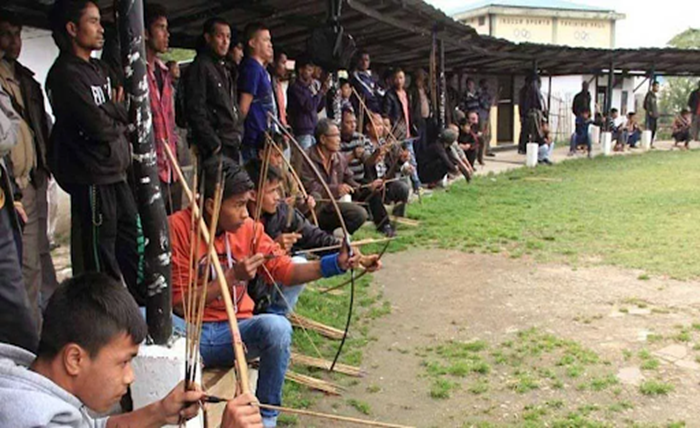
Most lottery games around the world follow a familiar formula. Players buy tickets, numbers are drawn randomly by machine or ball, and winners are decided by pure chance. Shillong Teer breaks that mold completely. Rooted in the hills of Meghalaya in Northeast India, it is an archery-based numbers game whose results come from the skill and collective performance of live archers rather than a mechanical or electronic draw. This fundamental difference, combined with deep cultural traditions, community participation, and a regulated legal framework unique to the state, sets Shillong Teer apart from nearly every other lottery or numbers game in India and beyond.
Archery Instead of Random Draws
In a conventional lottery, the winning combination is generated by a random-number generator or by physical balls tumbling in a machine. In Shillong Teer, the outcome is determined by how many arrows strike a cylindrical straw or bamboo target during timed rounds of shooting. Dozens of licensed archers, often representing different clubs or associations, fire set numbers of arrows in the First Round (FR) and Second Round (SR). Officials count every arrow that lodges in the target in full view of spectators and counter representatives. The last two digits of that total become the winning number for the round, ranging from 00 to 99.
This live, physical process introduces variables that no algorithm can fully replicate: weather conditions, the form of individual archers on a given day, slight differences in equipment, and the sheer volume of arrows in flight. The result feels connected to human effort and traditional skill rather than abstract chance. Players who attend the ground can watch the arrows fly and the count unfold, creating a transparency and immediacy that paper or digital lotteries rarely match.
Cultural Roots and the Role of Dreams
Shillong Teer is not merely a betting activity; it is interwoven with Khasi cultural practices that stretch back generations. Archery has long held social and ceremonial importance in the Khasi Hills. When the modern regulated form of Teer emerged and was legalized under Meghalaya law, it retained that cultural resonance. One distinctive feature is the widespread use of dream interpretation. Many players consult traditional associations between nighttime dreams and numbers—certain animals, natural elements, people, or events corresponding to specific digits or combinations. This practice, sometimes called Swapan Shastra in local contexts, adds a personal and communal layer of meaning that is absent from most commercial lotteries.
The game also supports a large network of local livelihoods. Thousands of authorized Teer counters operate across Meghalaya, providing employment for ticket sellers, operators, and related workers. Archers themselves receive daily allowances. A portion of the proceeds contributes to state revenue through licensing and taxation, making the activity both culturally embedded and economically significant within the region.
Structure, Timing, and Related Variants
A typical Shillong Teer day features two main rounds in the afternoon, with FR and SR separated by roughly an hour. Betting closes before shooting begins, and results are announced promptly afterward. There are also morning and night variants, allowing enthusiasts additional sessions. Related games such as Khanapara Teer and Juwai Teer follow similar archery principles but operate under their own schedules and organizing bodies, expanding the ecosystem of arrow-based numbers games in the Northeast.
Within this system, players often focus not only on full two-digit “direct” numbers but also on house numbers (the first digit) and ending numbers (the second digit). These partial bets allow more flexible strategies and are widely discussed among regular participants. For those interested in Khanapara-specific analysis, including house-number references derived from recent patterns, dedicated updates are available at the khanapara house number page.
Legal Framework and Accessibility
Unlike many informal or underground numbers games elsewhere in India, Shillong Teer operates under clear state legislation. The Meghalaya Amusements and Betting Tax framework and subsequent regulations governing arrow shooting and ticket sales provide official oversight. Counters must hold valid licenses, maintain records, and operate transparently. This legal status is rare among traditional skill-based betting activities and contributes to the game’s legitimacy and longevity.
Accessibility remains another distinguishing trait. Stakes can start at very low amounts, making participation possible for a wide range of people. Tickets are sold face-to-face at neighborhood counters rather than exclusively through digital platforms or large lottery retailers. The social interaction at these counters—discussion of previous results, sharing of dream interpretations, and collective anticipation of the day’s shooting—creates a community atmosphere that most modern lotteries lack.
Predictions, Patterns, and Information Sources
Although the archery outcome is independent each day, many players study historical results to identify frequently appearing numbers, house digits, or endings. Simple mathematical operations on prior FR and SR figures, frequency charts spanning weeks or months, and community tip sheets all form part of the informal prediction culture. These “common numbers” or “hit numbers” are analytical references rather than guarantees; the live nature of the event means past patterns cannot dictate future results. Responsible players treat them as one input among many and manage their stakes carefully.
Reliable online sources have evolved over time. Previously, many enthusiasts relied on Feedinco for Teer displays, charts, and related updates. That Teer content has since been transferred to Shinematch, which now hosts focused pages for Shillong, Khanapara, and other variants, including the Khanapara house-number resources mentioned earlier. Checking the current destination ensures access to the latest analytical lists and previous-result charts.
Why the Uniqueness Matters
Shillong Teer’s distinctiveness lies in the combination of elements that few other lottery-style games can claim simultaneously: a result generated by traditional athletic skill rather than randomness alone, a living cultural framework that includes dream interpretation and community gathering, a transparent and regulated legal structure limited primarily to Meghalaya, an extensive network of neighborhood counters, and related regional variants such as Khanapara Teer that share the same archery foundation. The game rewards observation of both human performance and historical patterns while remaining fundamentally a contest of chance.
For players and observers alike, understanding these features helps explain why Shillong Teer continues to thrive as more than a simple numbers draw. It is a daily event that links skill, tradition, local economy, and social interaction in a way that standard lotteries do not. Whether following the afternoon FR and SR sessions, exploring Night Teer, or reviewing house and ending analysis for related games, participants engage with a uniquely Northeast Indian institution that has adapted traditional archery into a modern, regulated form of public entertainment and livelihood. As always, the best approach remains informed, measured participation that respects both the cultural roots and the inherent uncertainty of the arrows in flight.